
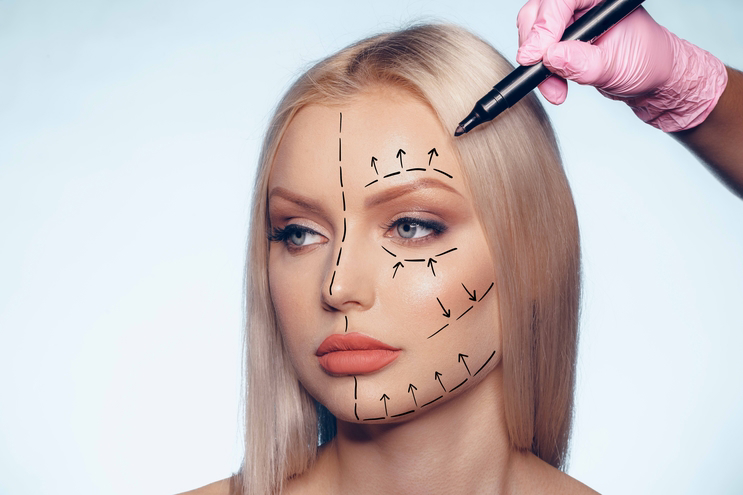
Facial harmony refers to the way different facial features relate to one another in terms of proportion, balance, shape, and overall appearance. Features such as the nose, chin, cheeks, forehead, lips, and jawline contribute to how the face is perceived as a whole. Plastic surgery can sometimes be used to modify specific features while maintaining the natural relationships between them.
The goal of facial plastic surgery is not necessarily to create identical or perfectly symmetrical features. Instead, procedures can be planned to address individual concerns while considering the person’s existing facial structure, proportions, and aesthetic preferences.
What Is Facial Harmony?
Facial harmony describes the visual balance between different facial features. The size, position, shape, and projection of one feature can influence how another feature appears.
For example, the relationship between the nose and chin can affect the appearance of the facial profile. Similarly, cheek volume can influence how the midface and jawline are perceived.
Because facial structures are interconnected, surgeons typically evaluate the face as a whole rather than considering one feature in complete isolation.
How Plastic Surgery Can Improve Facial Harmony
Plastic surgery can improve facial harmony by modifying selected facial features to create more balanced proportions. Depending on the individual’s anatomy and goals, this may involve procedures targeting the nose, chin, cheeks, jawline, eyelids, forehead, or other areas.
The appropriate approach varies considerably between individuals.
Rhinoplasty and Facial Proportion
Rhinoplasty is a surgical procedure used to change the shape or structure of the nose. Because the nose occupies a central position on the face, even relatively subtle changes can influence overall facial appearance.
A rhinoplasty plan may consider the nose’s width, projection, profile, tip shape, and relationship with surrounding features. The objective may be to create a nose that fits naturally with the individual’s facial proportions rather than making it look unrelated to the rest of the face.
Chin and Jawline Enhancement
The chin plays an important role in facial profile and lower-face proportions. A chin that appears relatively small or prominent can influence how the nose, lips, and jawline are perceived.
Procedures such as genioplasty or chin augmentation can modify chin projection or shape in selected patients. Jawline procedures may also alter the contour of the lower face.
These changes require careful assessment because increasing or reducing one area can affect the perceived balance of neighboring features.
Cheek Contouring
The cheeks contribute to midface structure and facial contours. Changes in cheek volume or projection can influence the relationship between the eyes, nose, lips, and lower face.
Depending on the individual’s anatomy, facial surgery may involve techniques designed to enhance, reduce, or reposition certain areas. The appropriate approach depends on factors such as bone structure, soft-tissue volume, skin characteristics, and aesthetic goals.
Eyelid and Forehead Procedures
The upper third of the face also contributes to overall facial balance. Eyelid surgery can address certain concerns involving excess skin or tissue around the eyes, while brow or forehead procedures may alter the position or contour of the upper face.
These procedures should be planned with surrounding structures in mind. Changes around the eyes and forehead can influence facial expression and overall appearance.
Facial Symmetry and Balance
Perfect facial symmetry is uncommon. Small differences between the left and right sides of the face are normal and can be part of an individual’s natural appearance.
Plastic surgery may sometimes address noticeable asymmetry, but the extent to which it can be corrected depends on the underlying anatomy. Differences caused by bone structure, soft tissue, muscle activity, or previous injury may require different approaches.
The goal is generally to improve balance rather than create mathematical symmetry.
The Importance of Facial Proportions
Facial proportions are an important consideration when planning cosmetic procedures. Surgeons may evaluate the relationship between the upper, middle, and lower thirds of the face, as well as the proportions between individual features.
For example, changes to the nose may be considered alongside chin projection, while cheek changes may be evaluated in relation to the jawline.
This comprehensive assessment can help ensure that a procedure is planned according to the individual’s overall facial structure.
Combining Facial Procedures
In some cases, more than one procedure may be considered to address related concerns. For example, a patient seeking profile refinement may require assessment of both the nose and chin.
Combining procedures can potentially address several aspects of facial balance, but it also increases the complexity of treatment. A qualified plastic surgeon should determine whether combined procedures are appropriate based on individual anatomy, health, goals, and surgical considerations.
Personalized Treatment Planning
There is no single definition of an ideal face. Facial features vary naturally according to age, genetics, ethnicity, anatomy, and individual characteristics.
For this reason, facial plastic surgery should be personalized rather than based on a standardized template. During consultation, a surgeon can assess facial structure, discuss the patient’s concerns, explain available options, and establish realistic expectations.
Digital imaging or other visualization techniques may sometimes be used to support the consultation, although they cannot guarantee a particular surgical result.
Natural-Looking Results
Improving facial harmony does not necessarily mean making dramatic changes. In many cases, subtle modifications may be considered to create a more balanced relationship between features.
A natural-looking result depends on factors such as appropriate procedure selection, surgical technique, individual anatomy, healing, and realistic expectations.
Patients should understand that every surgical procedure has potential risks, including complications related to anesthesia, infection, bleeding, scarring, asymmetry, or the need for revision.
Dr. Ahmad Houmsie is a highly skilled plastic and aesthetic surgeon in Dubai, with extensive clinical training and international credentials. He offers advanced cosmetic procedures for the face and body — including rhinoplasty, liposuction, breast surgery, tummy tuck, facelifts, and more — using state‑of‑the‑art techniques tailored to each patient. For anyone seeking expert guidance and transformative results, booking a consultation directly with Dr. Ahmad Houmsie ensures personalized care and professional excellence.